Five Presses of Peppermint, No Glass of Water, Nothing to Swallow
Shroomwell's Brain & Focus Spray is thirty milliliters of lion's mane, theanine, a little ashwagandha and three B vitamins from a mushroom company in Estonia. I counted what each press carries against what the studies used.

This is a paid advertisement. Sponsored by Shroomwell.

Nearly everything sold for the mind asks the same two things of you: a glass of water, and a swallow.
This small white bottle asks for neither.
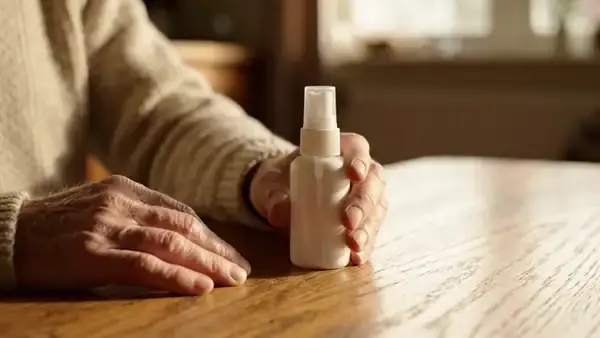
You take the cap off, press the pump into your mouth five times, and put the cap back on.
That gesture is the reason this page exists.
Five presses is the daily amount the seller prints, and five is a number a man can count on one hand.
So I did the arithmetic the gesture invites: what a single press carries, and how many presses each study would have needed.
One thing before anything else, said plainly: the seller ships only within Europe, and it does not refund an opened bottle.
Emmett Shaw is the pen name of this desk.
Everything on this page about the bottle comes from the seller's own shop, its label photographs, its contact page, its returns policy and its public review widget, all read on September 21, 2026.
The three customer reviews printed further down were written in Estonian, and I translated them.
The small pictures with them are illustrations, not the reviewers.
I have taken something every morning for eleven years, and every one of those mornings began at the kitchen tap.
Fill the glass, open the bottle, count out the dose, swallow, rinse the glass, put it on the rack.
It is a small ritual, and like most small rituals it had stopped being something I noticed.
Then I held a bottle that did not need the tap at all.
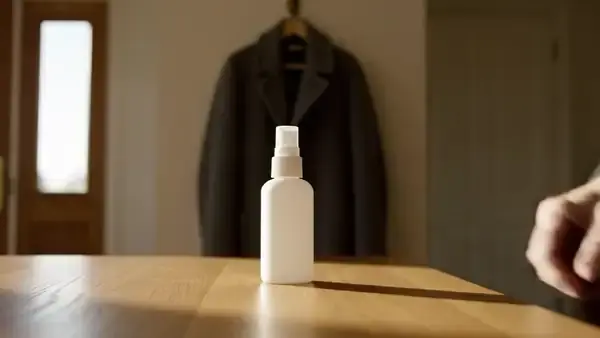
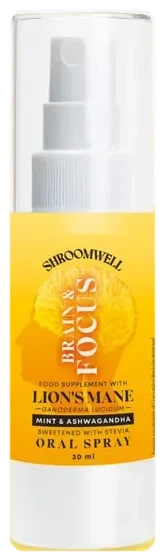
It is white, it is about the length of my index finger, and it has a clear cap over a pump.
It holds thirty milliliters, which is two tablespoons of liquid.
There is no glass in this ritual, no tap, and nothing to get down.
The label says the daily dose is five sprays.
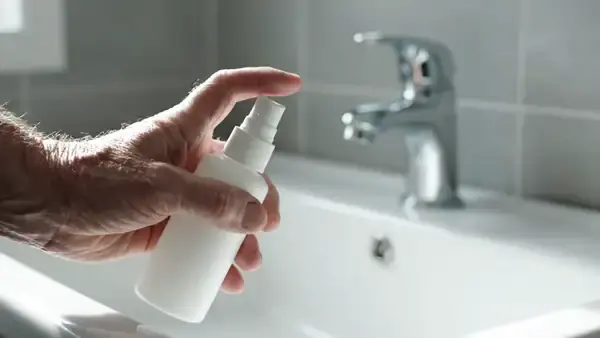
You shake it, you open your mouth, you press five times, and you are done before a kettle would have started to tick.
I am not going to pretend the gesture is unimportant, because it is the most distinctive thing about this bottle.
It is also, as it turns out, the most useful tool for understanding what is inside it.
A press is a unit, and a unit can be counted.
Once you know the daily amount of each ingredient is spread across five presses, you can divide.
And once you can divide, you can hold any published study up to the bottle and ask a very plain question: how many presses would that study have needed?
That question is the spine of this page.
It does not flatter the bottle and it does not insult it, and it can be checked by anyone with the label and a pencil.
Before I start counting, two facts that matter more than any number.
They decide whether this page is worth your next half hour at all.
First, the seller ships only within Europe.
If your address is in the United States or Canada, you cannot order this bottle from the company that makes it, and nothing on this page changes that.
Second, there is no refund promise.
There is the European fourteen-day right to change your mind, for a bottle that is unopened and unused, and that is all.
If both of those are fine with you, read on.
If either one ends the matter, you have lost two minutes rather than twenty euros, and I would rather you lost the two minutes.
Five Presses, Counted Out Loud
The instructions on the seller's shop are short, and they are the kind a man actually follows.
Prime the pump a few times before the first use, shake before each use, and always put the cap back on.
Priming means pressing the pump until the liquid reaches the nozzle.
The first two or three presses of a new bottle go into a sink or a tissue, not into you, and they come out of the same thirty milliliters.
After that, the daily dose is five sprays.
The label does not say whether to take them all at once or spread them through the morning, and I will not invent an instruction the maker did not give.
I took mine all at once, standing at the window, and I counted out loud the first few days.
Not because five is hard to remember, but because counting is the whole method of a spray.
With a capsule, the dose is decided in a factory.
With a spoonful of powder, the dose is decided by how level you keep the spoon.
With a spray, the dose is decided by your thumb, one press at a time.
Four presses is eighty percent of the label's day, and six is a hundred and twenty.
The spray puts the arithmetic in your hand, literally.
That is a responsibility as much as a convenience.
On a busy morning it is easy to lose count at three and guess at the rest.
My own answer was simple.
I say the numbers under my breath, and on the days I lose track, I stop at the number I am sure of rather than guessing upward.
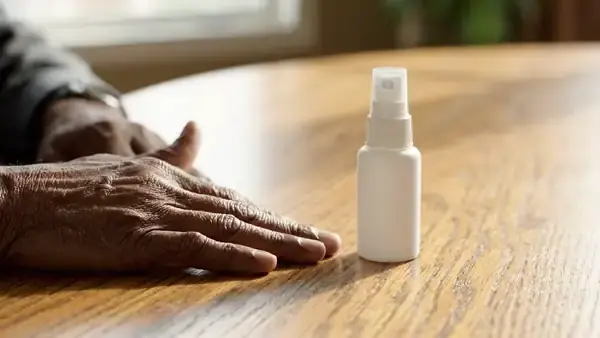
The bottle itself is built for this kind of use.
The seller calls it an airless bottle, which means the pump pushes liquid up without drawing air back in after each press.
That is why there is no straw inside and why the liquid does not slosh around a half-empty bottle the way it would in an ordinary pump.
It also means you cannot see how much is left, which is a small nuisance I will come back to.
There is no water in any of this.
Nothing is swallowed whole, nothing has to go down past the throat in one piece, and nothing needs to be chased with a drink.
For a man who has spent years getting capsules down with a full glass, that is a noticeable change.
For a man who travels, keeps odd hours or simply dislikes swallowing things, it may be the entire appeal.
The gesture is real, and it is pleasant. Whether the contents are worth the gesture is a separate question, and it takes the rest of this page.
Mornings Away From the Kitchen Tap
I promised to be fair to the gesture, so here is where it genuinely earns its keep.
It is on the mornings that do not start in your own kitchen.
A hotel room, a son's spare bedroom, an early train, a ferry across to Helsinki.
Those are the mornings when a man who takes something daily either finds a glass or skips it.
With a bottle that needs water, the ritual depends on a tap you trust and a glass that is clean.
With this one, it depends on a coat pocket.

Five presses take about ten seconds, standing up, with a coat on.
Nobody at the next table notices, and there is no little heap of capsules on a saucer to explain.
The spray travels the way a pen travels: in a pocket, forgotten until it is needed.
There is a second, quieter advantage that I did not expect.
Because the dose is counted with the thumb, it is very hard to take it twice by accident.
With a jar of capsules, a man can open the lid at nine, get distracted, and open it again at ten without being sure.
With a spray, the five presses are a small physical event, and I found I remembered doing them in a way I never remembered swallowing a capsule.
That is not a claim about memory, and I will not dress it up as one.
It is only an observation about habits: a gesture you perform with your own hand is easier to recall than one you perform with a glass of water on autopilot.
The flip side is equally real.
A bottle that lives in a pocket is a bottle that goes through the wash, gets left in a hired car, or sits in a warm glovebox all summer.
The label asks you to put the cap back on after every use.
It does not print a storage temperature that I could find, so the sensible course is the one for any liquid supplement: a cool, dry place, cap on, out of the sun.
And if the bottle goes on holiday with you, remember that the airless design hides the level.
Take a spare on a long trip, because you will not see the last week coming.
The Bottle, the Company and the Road It Travels
The full name on the shop is Brain & Focus Spray with Lion's Mane, thirty milliliters, in a white pump bottle about the length of an index finger.
It is sold by Shroomwell, a company whose contact page gives an office address at Treiali tee 2 in Peetri, just south of Tallinn.
That same contact page lists three more addresses.
A mycology laboratory in Tallinn, a factory in the small town of Tõrva, and a mushroom farm in Tõrva as well.
I note those as the company's own description of itself, and nothing more.
The page does not say that the lion's mane in this particular bottle was grown on that farm, and I will not say it either.
What I can say is that the company publishes a street address, a telephone number, +372 55 11 446, and an email address, info@shroomwell.com.
When a small bottle travels across borders, a real address and a number that rings somewhere matter more than any picture on a shop page.
It is sold as a food supplement under European rules, not as a medicine.
That matters for the claims on the label, which I will read out line by line further down.
Now the road it travels, because the seller is direct about it and so will I be.
Shroomwell ships to Estonia, to Latvia and Lithuania, to Finland and Sweden, and to the rest of Europe.
Postage inside Estonia starts at 2.99 euros, and to Latvia and Lithuania it is 5.99.
To Finland and Sweden it is 9.99, and to the rest of Europe it is 12.99.
Above a certain order size the postage is waived in the nearer zones.
That is from 49 euros inside Estonia, from 59 to Latvia and Lithuania, and from 99 to Finland and Sweden.
There is no zone for the United States.
I looked, and the shop's own shipping list stops at Europe.
If you live in Ohio, this bottle does not come to you. That is the first honest fact about it.
If you live in Europe, or keep a house there, or have a son in Stockholm who could forward a parcel, it does.
The rest of this page is for you, and for anyone who simply wants to know how to read a bottle like this one.
On the shop the price is shown in euros.
I do not print it here, because the seller sets it and changes it, and a number on this page would be wrong the week it changed.
The Arithmetic of a Single Press
Here is the panel for a daily dose of five presses, as the seller prints it.
I have copied the amounts exactly and added nothing.
- Lion's mane extract (Hericium erinaceus): 250 milligrams
- L-theanine: 50 milligrams
- Ashwagandha root extract (Withania somnifera): 25 milligrams
- Vitamin B1, as thiamine: 0.55 milligrams, 50 percent of the European reference intake
- Vitamin B3, as niacinamide: 8 milligrams, 50 percent of the European reference intake
- Vitamin B12, as methylcobalamin: 250 micrograms, 10,000 percent of the European reference intake
The rest of the liquid is the base.
Purified water, xylitol, glycerol, stevia sweetener, citric acid, potassium sorbate as a preservative, xanthan gum to thicken it, and peppermint oil for taste.
Now divide every line by five, because five is how many times your thumb goes down.
That gives you what one press carries.
- Lion's mane extract: 50 milligrams
- L-theanine: 10 milligrams
- Ashwagandha root extract: 5 milligrams
- Vitamin B1: 0.11 milligrams
- Vitamin B3: 1.6 milligrams
- Vitamin B12: 50 micrograms
Those are small numbers, and that is not a criticism.
A spray delivers a fine mist of liquid, and a fine mist cannot carry a gram of anything.
It is simply the physical fact of the format.
A capsule can hold several hundred milligrams of powder, a spoonful of powder can hold a few grams, and a press of a pocket pump holds what a press holds.
The whole question of this bottle is whether fifty milligrams a press, five presses a day, lines up with anything that has been studied.
So I took each ingredient in turn and did one thing with it.
I found the amount the best available study used, in the same unit, and divided it by what one press carries.
The answer is a number of presses.
It is the easiest way I know to see the distance between a label and a trial without any adjectives getting in the way.
The Mushroom, Counted in Presses
Lion's mane is a white, shaggy mushroom that grows on hardwood, oak among it.
It is eaten as food in parts of East Asia, and it is the ingredient this bottle is named for.

The study most often cited for it in older adults was run in Japan.
Thirty-one healthy adults over fifty took either a lion's mane preparation or a placebo every day for twelve weeks. [1]
The lion's mane group scored higher on a standard mental-status test than the placebo group.
A second test in the same study, of visual memory, did not change.
The daily amount in that study was 3.2 grams of the mushroom's fruiting body.
That is 3,200 milligrams.
Divided by the 50 milligrams a press carries, that is sixty-four presses a day, more than twelve days of this bottle's printed dose every day for twelve weeks. [1]
The trial used the whole dried fruiting body, while this bottle uses an extract whose strength the label does not state.
I want to be fair to the bottle here, because that last point matters.
An extract is not the same as the whole mushroom.
Extraction can concentrate some compounds and leave others behind.
Fifty milligrams of a strong extract could, in principle, stand in for more than fifty milligrams of dried mushroom.
The label does not print an extraction ratio.
So I cannot tell you whether fifty milligrams of this extract equals fifty milligrams of mushroom, or two hundred, or five hundred.
What I can tell you is that the only comparison the label allows is milligram against milligram, and on that comparison the trial is sixty-four presses away.
There is a second lion's mane study worth knowing about, run in Britain.
Forty-one healthy adults aged eighteen to forty-five took a single dose of 1.8 grams, or a placebo. [2]
An hour later, the lion's mane group was faster on the Stroop task, a test where you name the color a word is printed in rather than read the word.
The same volunteers then took the supplement for twenty-eight days, and that longer part produced only a trend that did not reach significance.
In presses, 1.8 grams is thirty-six presses of this bottle.
That is seven days of its printed dose in one sitting, in people young enough to be the grandchildren of most readers here.
Sixty-four presses for the twelve-week trial. Thirty-six for the one-hour test.
Neither number is an insult to the bottle.
They are what the research used, and the bottle uses what a pocket pump can deliver.
But a man deciding whether to spend his money should know that no lion's mane study I could find used anything close to 250 milligrams a day of an extract.
If you buy this bottle for the mushroom, you are buying the mushroom at a small fraction of any amount that has been tested in people.

One more thing about the mushroom, because it is printed on the bottle and it would be odd to skip it.
The seller's own photographs show two Latin names.
The box prints Hericium erinaceus, which is lion's mane.
The bottle's label, in the seller's own photographs, prints Ganoderma lucidum, which is the Latin name of reishi, a different mushroom.
The ingredient list on the shop names Hericium erinaceus.
I take that as the intended ingredient and the bottle's line as a printing slip, but it is a slip on the one line that names the thing the bottle is sold for.
It does not change the arithmetic above.
It is the kind of detail a careful buyer notices, and a careful company corrects on its next print run.
Lion's Mane on a Plate, and Lion's Mane in a Press
It helps, before going further, to remember that lion's mane is a mushroom people cook.
In markets where it is sold fresh, it looks like a white pompom of soft hanging spines, and it is sliced and fried in butter like any other mushroom.
Cooks describe its texture as tender and a little stringy, and its taste as mild.
It is food first, and it has been food for a very long time.
That matters for two reasons, and neither of them is a promise.
The first is that a mushroom eaten as food has a long record of being eaten, which is some comfort about the ingredient itself.
The second is that food and a dose are measured in completely different ways.
A plate of fried mushroom is weighed in grams of mostly water, while a trial counts grams of dried fruiting body, and a spray counts milligrams of an extract.
A plate, a trial and a press: three different scales for the same white mushroom.
None of those three can be converted into the others without numbers the label does not print.
So I will not tell you that five presses equal a forkful, or a slice, or a bowl, because I cannot know it.
What I can tell you is simple and slightly deflating.
If you enjoy mushrooms, a fresh lion's mane from a good market is a pleasant thing to cook on a Sunday, and it asks nothing of anyone's research to be worth eating.
And if you buy the spray, you are buying something different from that dinner.
You are buying a small, measured, portable amount of an extract, taken with your thumb, and the case for it rests on the arithmetic above rather than on the mushroom's reputation.
The mushroom's reputation is large and the amount in a press is small. Both things are true at once.
Theanine, Ten Milligrams at a Time
L-theanine is an amino acid found in tea leaves, and green tea is where most people meet it.
The bottle carries 50 milligrams a day, so ten milligrams a press.
There is a study of theanine in exactly the age group of most readers here, run in Japan.
Men and women aged fifty to sixty-nine took a single dose of theanine or a placebo. [3]
After the theanine, reaction time on an attention task was faster.
On a working-memory task there were more correct answers and fewer missed items.
The published summary of that study does not state the dose.
So I cannot turn it into presses, and I am not going to guess a number to make the page tidier.
There is a second study that does state it.
Thirty healthy adults averaging forty-eight years old took 200 milligrams of theanine a day for four weeks, and a placebo for another four. [4]
On theanine, their scores on verbal fluency and on a test of planning and switching were better.
Against placebo, the verbal-fluency gain showed up in the half of the group who had started with lower scores.
Two of that study's authors worked for the company that supplied the theanine.
That does not make the result wrong, but it belongs in the same sentence as the result.
In presses, 200 milligrams is twenty presses a day.
That is four days of this bottle's printed dose, every day, for four weeks.
Twenty presses for the theanine study. The bottle gives you five.
Theanine is, of all the lines on this panel, the one closest to its study.
It is still a quarter of the way there.
Five Milligrams of Root per Press
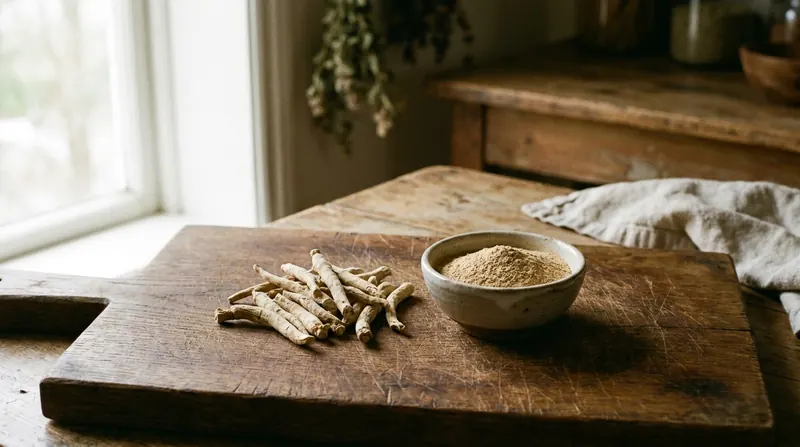
Ashwagandha is the root of a small shrub used for centuries in India.
This bottle carries 25 milligrams of a root extract a day, which is five milligrams a press.
The better-known study of it on memory and focus was run in India in 125 healthy adults aged twenty to fifty-five.
They took 300 milligrams a day of a sustained-release root extract, or a placebo, for ninety days. [5]
The ashwagandha group scored better on memory and focus tests at the end.
It was a younger group than most readers here, and it was a single trial.
In presses, 300 milligrams is sixty presses a day.
That is twelve days of this bottle's printed dose, every day, for three months.
A second study, in the United States, used 225 milligrams of a different form of the root.
Fifty-nine young adults, averaging twenty-three years old, scored better than placebo on some measures of word recall, reaction time and attention. [6]
In presses, 225 milligrams is forty-five presses.
And the average participant was forty years younger than the average reader of this page.
Sixty presses, and forty-five. The bottle gives you five.
So the ashwagandha in this bottle is best understood as a small supporting line, not a working amount.
The seller's own label says only that ashwagandha contributes to normal mental and cognitive activity, which is a general statement rather than a promise about any particular amount.
There is one practical note on ashwagandha that matters more than the arithmetic.
Rare reports of harm to the organ that processes what you swallow have been described with ashwagandha products.
If you notice unusual tiredness, dark urine, or yellowing of the skin or eyes, stop and speak to your clinician.
It is not for use in pregnancy, and if you take anything daily, it belongs on the list you show your pharmacist.
Three Vitamins, and the One Printed at Ten Thousand Percent
The last three lines on the panel are the B vitamins, and they are the lines that behave differently from everything above.
Here the question is not whether the bottle reaches an amount, but whether it overshoots one.
Vitamin B1, thiamine, is 0.55 milligrams a day.
The European reference intake for thiamine is 1.1 milligrams, so the label's fifty percent is exactly right. [7]
On an American label the same amount would read differently, because the US Daily Value for thiamin is 1.2 milligrams. [8]
Here it would be about forty-six percent.
Vitamin B3, niacin, as niacinamide, is 8 milligrams a day.
The US Daily Value for niacin is 16 milligrams, so on either side of the Atlantic that line reads as half a day. [8]
And then vitamin B12, at 250 micrograms a day.
The European label calls that 10,000 percent of the reference intake.
The US Daily Value for vitamin B12 is 2.4 micrograms. [8]
Measured against that, 250 micrograms is a little over a hundred and four times the day.
In presses, one single press of this bottle carries 50 micrograms of B12, which is about twenty-one days of the US Daily Value.
That sounds alarming, and it is not.
The US National Institutes of Health states that vitamin B12 has no upper limit, because of its low potential for harm. [9]
The same fact sheet says something more useful for men of our age.
Depending on how it is measured, somewhere between three and forty-three percent of older adults living at home run low on B12. [9]
Part of the reason is the stomach.
With age, many stomachs make less of what is needed to release B12 from food, while the B12 in supplements is already unbound and does not need that step. [9]
That point matters for this bottle in a way the seller does not make.
The advantage of supplement B12 comes from its form, not from being sprayed, and a capsule or a fortified cereal delivers the same unbound form.
So the B12 line is the one line on this panel that is not short of anything.
It is, if anything, generous.
Now the harder part.
Does extra B vitamin do anything for thinking in a man who is not short of it?
The largest honest answer is a Cochrane review of fourteen trials in 27,882 adults without memory problems.
It found that B-vitamin supplements probably have little or no effect on overall thinking at any point up to five years. [10]
Enough B12 matters. Extra B12, in a man who already has enough, has not been shown to add anything.
The only way to know which of those two men you are is a blood test.
Ask your clinician for a B12 level if nobody has checked it in a few years.
That test costs less than most bottles and tells you more than any of them.
If it comes back low, the next step will come from someone who can see the number, and if it comes back fine, you will know the B12 line is not what you are paying for.
The panel also prints three European health claims for these vitamins.
They are claims the European Union authorizes for any food that carries enough of the vitamin. [11]
Vitamins B3, B1 and B12 contribute to normal psychological function and to the normal functioning of the nervous system.
Vitamins B12 and B3 contribute to the reduction of tiredness.
The important word in every one of them is "normal."
They describe what these vitamins do in everyone, and they are not a promise that more of them does more.
What the Seller Says About Spraying
Before the seller's own words about the format, the bottle itself, which I have kept off this page until the numbers were down.
Everything above was about what is inside it; this is the thing you would actually hold.
The shop makes one claim about the format itself, and I will quote it exactly.
"Sprays have high absorption rate, as they produce perfectly sized droplets that can be directly absorbed by the bloodstream, rather than the digestive system."
I looked for evidence behind that sentence on the seller's pages.
There is no study cited, and I found no trial comparing this spray with the same ingredients swallowed.
That does not make the sentence false.
It makes it a statement by the seller, which a reader should weigh as a statement by the seller.
Here is what I can say with some confidence.
A press of liquid in the mouth does not stay there for long, and most of it is swallowed within a minute or so, like any liquid.
So in practice, most of what you spray ends up where a capsule would have ended up anyway.
The difference is how it gets there: without water, without a lump to swallow, and in a peppermint mist.
The gesture is the advantage I can vouch for. The absorption claim is one I cannot, and I would not buy the bottle on it.
If the seller one day publishes a trial comparing its spray with the same ingredients in a capsule, I will read it with interest.
Until then, the fair way to judge this bottle is on its amounts, as if every press were swallowed.
A Pocket, a Cap and a Taste of Mint
If the amounts are modest, the everyday qualities of the bottle are where it earns its place.
And on that score the three reviews I translated say more than the label does.
The first is from a customer who calls herself Liisi, and she gave it five stars.
She likes that she can carry it in her bag and use it anywhere.
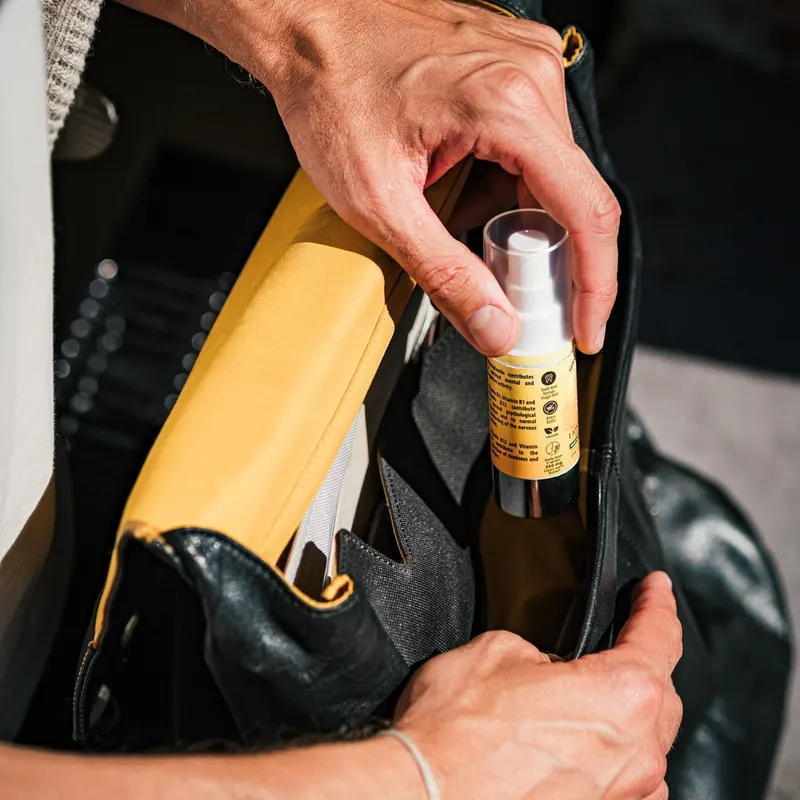
That is the gesture again, seen from the side of daily life.
A bottle that fits in a coat pocket, needs no water, and takes ten seconds to use goes where a jar of capsules does not.
Liisi also mentions a flaw, and I am glad she did.
The cap sticks sometimes, she writes, and she found that cleaning it with water makes it work perfectly again.
That is exactly the kind of practical detail a label never prints.
Peppermint oil, glycerol and a thickener are what keep the mist fine, and they are also what leave a film on a nozzle.

I like that I can carry it in my bag and use it anywhere. The cap sticks sometimes, but I found that if you clean it with water it works perfectly again.
Rinse the cap now and then. It is the one piece of maintenance a spray asks for.
The second review is from Marit Must, and she gave it three stars.
She is happy with the effect and unhappy with the flavor, and she says so in one line.
I will not argue with her palate.
The base is stevia and xylitol with peppermint oil, and I would describe the taste as sweetish, minty and faintly bitter underneath, which is the mushroom extract making itself known.

The effect is good, but the taste is a long way from pleasant peppermint.
The third review, four stars, is the longest and the most useful, from Marta Harjus.
She used it for about a month and describes clarity and energy at first, and a weaker effect as the weeks went on.
She also had to take it in the morning, because taking it later pushed her bedtime much later than usual.
I pass that on as her experience, and as a reason to keep your five presses to the first half of the day.

I ordered it and have been using it for about a month. At first it had an effect: it gave me clarity of thought and energy. I had to take it in the morning, because taking it later pushed my bedtime much later than usual. Over time the effect no longer felt as strong.
Those three reviews are printed in full above, each one right after what I made of it.
They are three of seventeen on the seller's shop, all written in Estonian.
Of those seventeen, twelve give five stars, three give four and two give three, and none gives fewer.
None of them carries the widget's mark of a confirmed purchase, which is why I call them reviews rather than proof.
I left two reviews out and I will tell you why.
One mentions a medical condition, and I do not print those, and one compares the bottle to another format using a word this journal does not use.
Individual experiences are not evidence. They are, however, the best description you will get of what it is like to live with the bottle.
Peppermint, Xylitol and the Dog in the Kitchen
The bottle is made without sugar.
Its sweetness comes from stevia and from xylitol, a sugar alcohol also found in chewing gum and toothpaste.
Xylitol is harmless to people in the amounts in a mouthful of spray.
The US Food and Drug Administration notes that in people it does not trigger the release of insulin. [12]
In dogs it is a different story entirely.
The same agency explains that in dogs xylitol is absorbed quickly and can cause a rapid, severe drop in glucose within ten to sixty minutes. [12]
A small bottle that lives in a coat pocket, or on a low kitchen shelf, is exactly the kind of thing a curious dog finds.
If there is a dog in your house, keep the bottle high up and the cap on, the same way you would with gum made without sugar.
Peppermint oil is the flavor, and it is the last line on the ingredient list.
Some people find mint strong, and rarely it can bring on heartburn or an allergic reaction.
Glycerol, citric acid, potassium sorbate and xanthan gum are there to carry, preserve and thicken the liquid.
They are ordinary food ingredients, and none of them is doing anything for your memory.

The Fourteen Days, and the Bottle You Have Opened
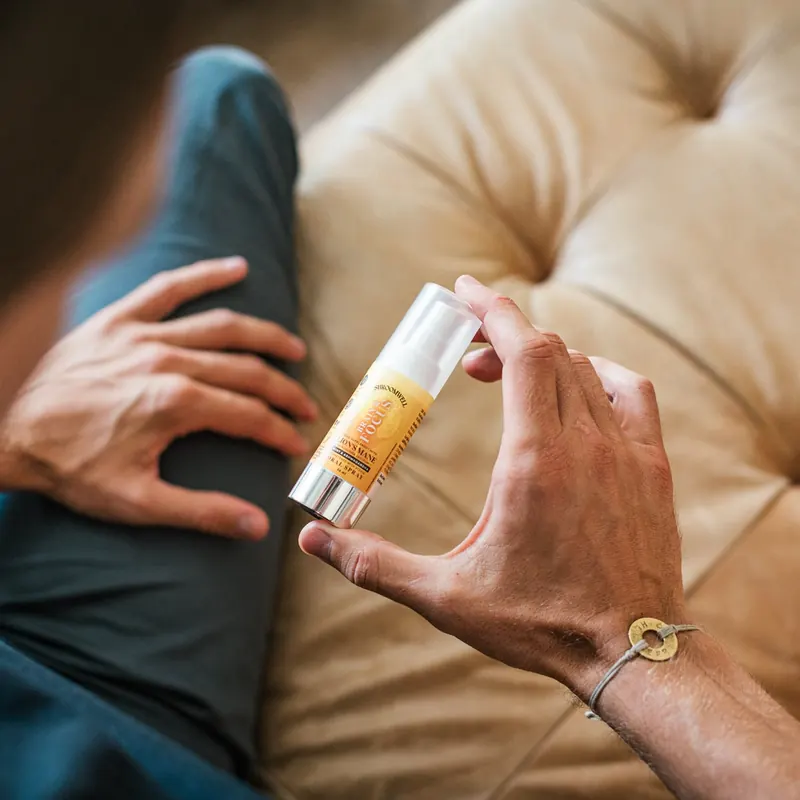
Every bottle on every shelf deserves the same question before the price: what happens if I do not like it?
With this one, the honest answer is short.
Shroomwell does not offer a refund promise.
What it offers is the European right of withdrawal, which every shop selling at a distance inside the European Union must offer.
You have fourteen days from the day the parcel arrives to return the product without giving a reason.
The bottle has to go back in its original condition, unopened and unused.
Opened or used bottles are not refunded unless they are defective.
The return postage is yours to pay, unless the bottle was defective or the wrong one was sent.
Once the shop receives a return, the seller says the refund follows within fourteen days.
That is the full extent of it.
You cannot open this bottle, test it and send it back. You can only decide not to open it.
I do not say that to scold the seller.
A liquid you have sprayed into your mouth is hard to resell, and many small European shops work exactly this way.
But it changes how a sensible man buys it.
With a refund promise, the first bottle is a trial; without one, the first bottle is a purchase.
So buy one bottle, not three, and make the first one count as a fair test.
One small practical note on that first bottle.
Because the airless design hides how much liquid is left, you will not see the level drop the way you would in a clear jar.
The seller does not print how many presses a bottle holds.
Marta's review describes about a month of use, which fits five presses a day, but I cannot give you an exact count and I will not invent one.
A Fair Month, Counted Out
If you decide to buy it, here is the way I would use the one bottle you get to judge it by.
It costs nothing extra, and it turns a vague impression into something you can actually read back.
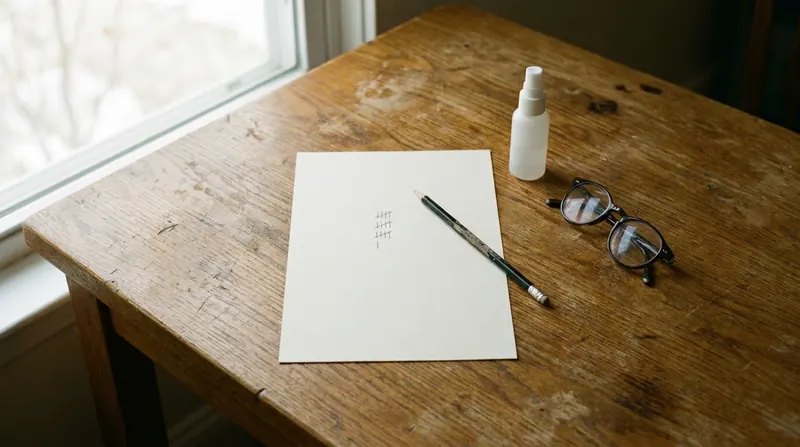
- Take the five presses at the same hour every morning, before noon, standing still, and count them out loud.
- Keep a small notebook beside the bottle and write one line a day: the date, five strokes, and one sentence about your morning.
- Change nothing else for that month, not your coffee, not your walk, not your bedtime, so that the bottle is the only thing that moved.
- Rinse the cap under the tap once a week so the nozzle keeps its fine mist.
- At the end of the month, read the first week's lines against the last week's.
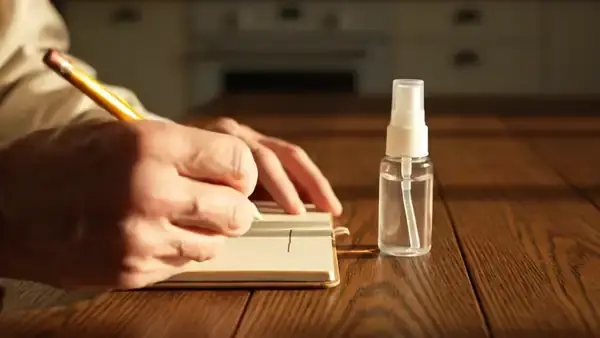
Marta's month is a useful map for what you may find.
She felt something at first and less later, which is a pattern worth watching for in your own lines.
If your notes look the same in week four as in week one, you have learned something real.
If they looked better in week one and faded, the novelty of a new morning ritual may have been doing some of the work.
Either answer is worth having.
It is certainly worth more than a bottle kept going for six months on a feeling nobody wrote down.
The spray makes this easy, because it already asks you to count. A notebook just keeps the count honest.
Reading Any Spray on the Shelf the Same Way
The method on this page is not special to this bottle.
It works on any spray, any drops and any liquid that measures its dose in presses, drops or squeezes.
It takes five minutes, a pencil and the back of the box.
Here it is, step by step, as I would teach it to a friend at the kitchen table.
Step one: find the daily dose in the maker's own unit.
Here it is five sprays, and on other bottles it may be two pumps, twenty drops or one squeeze.
Step two: copy each ingredient's daily amount, in milligrams or micrograms.
If a line has no amount beside it, write "no amount printed," because that fact is itself worth writing down.
Step three: divide each amount by the number of presses.
That is what one press carries, and it is the number your thumb actually delivers.
Step four: find the best study you can for each ingredient, and write down its daily amount in the same unit.
Look for a trial in people, with a placebo, in adults near your own age where you can.
Step five: divide the study's amount by what one press carries.
The answer is the number of presses the study would have needed, and you can set it beside the number on the label.
Here is step five done once, for the mushroom, on one card you could copy onto the back of any box.
Five on the label, sixty-four in the trial. The gap is the finding.
There are three honest cautions to the method, and I have tried to observe them all on this page.
They matter as much as the arithmetic.
The form matters.
An extract is not the whole plant, and a label that prints no extraction ratio leaves the comparison as milligram against milligram.
The people matter.
A study in twenty-three-year-olds is a study in twenty-three-year-olds, and a man of sixty-eight should read it as a hint rather than a promise.
The direction matters.
A line that falls short of its study is a question about the amount, while a line that overshoots its day, like the B12 here, is a question about whether you needed any at all.
Used that way, the method makes no judgment about a company or a plant.
It simply shows you, in a unit you can hold in your hand, how close a bottle comes to the research it is sold beside.
Every bottle on the shelf can be read this way. Very few are ever read this way.
Things No Press Replaces
It would be dishonest to write nine thousand words about five presses and leave out the things that matter more.
None of them comes in a bottle, and none of them can be sold to you by anyone.
Water.
In a study of 1,111 Berliners aged sixty to eighty-nine, the third who were measurably short of fluids did worse over time on a test of processing speed. [13]
A review of eighteen studies in older adults found only sparse evidence on water and thinking, and that is the honest size of it. [14]
But a glass of water costs nothing, and this is the one bottle on your shelf that no longer needs one.
The pattern of what you eat.
In a three-year trial of 604 older adults, a group eating the MIND pattern of greens, berries, beans, nuts, olive oil and fish, and a group eating slightly less, both improved on thinking tests by about the same amount. [15]
And in a Brazilian study of 10,775 adults followed for about eight years, those who ate the most ultra-processed food slipped somewhat faster on thinking tests. [16]
Both findings point the same unglamorous way: the plate over years matters more than any single thing.
Alcohol.
In British civil servants followed for thirty years, heavier drinking went with faster slippage on a word-fluency test, and light drinkers had no edge over those who did not drink at all. [17]
The B12 test, which I have already mentioned and will mention once more because it is so cheap.
It is the single most useful thing on this page, and it involves no press at all. [9]
Your hearing and your glasses.
Straining to hear a name, or to read a menu, looks a great deal like forgetting it.
A walk, most days, and people to talk to.
They are old advice because they have lasted.
A spray can sit beside these habits. It cannot stand in for any of them.
And the bag for the pharmacist.
Once a year, put everything you take into one bag, this bottle included, and ask your pharmacist whether anything in it argues with anything else.
That matters here because of the ashwagandha, and because a spray is easy to forget about when someone asks what you take.
It does not look like a supplement, and it does not live with the others.
If You Are Buying It for Someone Else

A good many small bottles like this one are bought as presents.
A daughter in Riga sends one to her father, or a wife picks one up for a husband who hates swallowing capsules.
If that is you, the arithmetic above still applies, but a few practical points apply more.
They are the ones I would want a relative to know before the parcel is wrapped.
Check the address first.
The seller sends to European addresses only, so a present for a father in Florida has to travel another way, and the shop itself will not take it there.
Do not open it to try it.
An opened bottle cannot be returned, so a gift that turns out to be unwanted should stay sealed, and the fourteen days start when the parcel arrives.
Tell him what is in it.
A spray does not look like a supplement, and a man who is asked what he takes daily may simply forget it, which matters because of the ashwagandha line.
Mind the dog.
If the house has one, the bottle belongs on a high shelf, for the xylitol reason above.
A present that comes with its terms explained is a better present.
And perhaps the kindest thing to include is the notebook.
Five presses, one line a day, a month of mornings, and an honest conversation at the end of it about whether it was worth continuing.
That conversation is worth more than the bottle, whichever way it goes.
It is also the only way either of you will know.
Who Might Keep It, and Who Should Leave It on the Shelf
After all the counting, here is how I would sort the readers of this page.
It is not a verdict on the bottle, only on who it suits.
It may suit you if you live in Europe, you dislike swallowing capsules, you want something small you can carry, and you are content with modest amounts and a pleasant ritual.
In that case, one bottle, a notebook and a fair month is a reasonable way to spend twenty-odd euros.
It may suit you if you already know your B12 runs low and your clinician has said a supplement is sensible.
Then the B12 line is doing honest work, and the peppermint mist is a nice way to take it.
It will not suit you if you live in the United States, because it will not be sent to you.
There is no way around that on the seller's own shop.
It will not suit you if you want the amounts the studies used.
For lion's mane that is sixty-four presses a day, and no man is going to press a pump sixty-four times before breakfast.
It will not suit you if you want to try it and return it.
Without a refund promise, an opened bottle is yours.
Speak to your pharmacist or clinician first if you take anything daily, if you are pregnant, or if you have ever reacted badly to mushrooms.
The same goes if you have a dog that finds everything, for the reason above.
None of this is a knock on a well-made little bottle. It is simply where the arithmetic and the terms leave it.
Every ingredient in this bottle, with the amount the label gives, what it is, what the research says about it and the cautions that go with it, is written out in full in the ingredient guide linked at the foot of this page.
That guide also carries the references in full and the disclosures this page is required to make.
One bottle, sent from Peetri to a European address
"Boost your focus, sharpen your mind and stay alert with Brain & Focus Spray."
SEE THE SPRAY ON SHROOMWELL'S SHOPSold and shipped by Shroomwell, Peetri, Estonia · Europe only, postage by zone · 14-day European right of withdrawal for unopened bottles, return postage paid by you · Opened bottles are not refunded unless defective
Quick answers about the five presses
Is this a medicine?
No. It is a food supplement sold under European rules, and it is not meant for any medical condition.
Can I order it from the United States?
Not from the seller. Its shop ships to Estonia, Latvia, Lithuania, Finland, Sweden and the rest of Europe only.
How much does one press carry?
A fifth of the daily dose: 50 mg of lion's mane extract, 10 mg of L-theanine, 5 mg of ashwagandha and 50 micrograms of B12.
Do I need water with it?
No. You press the pump into your mouth five times and put the cap back on.
How many presses would the lion's mane trial have needed?
Sixty-four a day, for twelve weeks, milligram for milligram. [1] The label does not say how concentrated its extract is.
Is 10,000 percent of B12 too much?
The US National Institutes of Health sets no upper limit for B12. [9] Whether you need any extra is a question for a blood test.
What if I do not like it?
You can return it within fourteen days only if it is unopened and unused, at your own postage. There is no refund for an opened bottle.
How do I reach the seller?
By email at info@shroomwell.com or by telephone on +372 55 11 446.
The Spray in Thirteen Lines
- A thirty-milliliter white airless spray bottle of lion's mane, theanine, ashwagandha and three B vitamins, made without sugar and flavored with peppermint.
- Five presses a day into the mouth, with no water and nothing to swallow whole; prime the pump first and shake before each use.
- One press carries 50 mg of lion's mane extract, 10 mg of L-theanine, 5 mg of ashwagandha, 0.11 mg of B1, 1.6 mg of B3 and 50 micrograms of B12.
- The twelve-week lion's mane trial in adults over fifty used 3.2 grams a day of the dried mushroom, which is sixty-four presses of this bottle. [1]
- The one-hour lion's mane test used 1.8 grams, thirty-six presses, in adults aged eighteen to forty-five. [2]
- The four-week theanine study used 200 mg a day, twenty presses. [4]
- The ashwagandha studies used 300 mg and 225 mg a day, sixty and forty-five presses, in adults younger than most readers here. [5] [6]
- B12 at 250 micrograms is more than a hundred times the US Daily Value, [8] has no upper limit, and is worth checking with a blood test instead. [9]
- The best review of B vitamins in adults without memory problems found little or no effect on thinking up to five years. [10]
- The seller says spraying improves absorption, and publishes no study comparing the spray with the same ingredients swallowed.
- The box prints Hericium erinaceus and the bottle, in the seller's own photographs, prints the Latin name of reishi.
- Europe only; no refund promise; fourteen days to return an unopened bottle at your own postage.
- Three of seventeen reviews on the seller's shop are printed in full further up, translated from Estonian.
Five Presses, Then the Cap Back On
I have used the bottle for a good while now, standing at the window and counting under my breath.
The ritual is pleasant, and I like it more than I expected to.
There is something about not needing the tap that makes a morning feel lighter by one small step.
And there is something honest about a dose you count with your own thumb.
I also like that the company behind it answers its telephone in Estonia and prints its address on its own pages.
That is not a small thing when a parcel crosses a border and something about it goes wrong.
And I like that the seller does not pretend.
Its own label makes European health claims in the careful wording the law requires, and it does not print a single promise about memory.
The weakest sentence the seller writes is the one about absorption, and even that is a sentence rather than a study.
I would rather a company write one unsupported sentence than a page of them.
But the counting also told me the plain truth about the contents.
Every studied amount on this panel needs between twenty and sixty-four presses a day against the label's five. The B12 is the exception, and it overshoots its day with the first press.
So I would describe this bottle as a well-made, pleasant way to take a small amount of several things, and a generous amount of one.
I would not describe it as the amount any study used, because it is not, and the seller does not claim that it is.
If you are in Europe and the gesture appeals to you, buy one bottle, count your presses and write your lines.
If you are anywhere else, or you want the studied amounts, this is not your bottle, and that is a perfectly good answer too.
Five presses, the cap back on, and a line in the notebook. That is the whole of it.
Five presses a morning, and one bottle to judge them by
"Boost your focus, sharpen your mind and stay alert with Brain & Focus Spray."
SEE THE SPRAY ON SHROOMWELL'S SHOPShroomwell, Treiali tee 2, 75312 Peetri, Estonia · +372 55 11 446 · info@shroomwell.com · Ships within Europe only · No refund on opened bottles
P.S. If you remember one number from this page, make it sixty-four.
That is how many presses of this bottle the twelve-week lion's mane trial would have needed each day, and it is the clearest way I know to see what a spray can and cannot carry.
P.P.S. If a worry about your own memory has been with you for months, speak to your own clinician before you buy anything at all.
A bottle of any kind was never going to answer a question that a proper appointment and a blood test can answer in an afternoon.